Certifications
The technology behind the material, and the standard it is held to
Save Green Eco Industries is proud to be associated with DRDO for the development and manufacturing of 100% compostable and biodegradable solutions.

Government of India | Ministry of Defence
Official association
DRDO – DFRL Technology
Our products are manufactured using the prestigious Technology Transfer from Defence Food Research Laboratory (DFRL) – DRDO. This ensures that every product we manufacture meets the highest standards of biodegradability and environmental safety as mandated by the Indian Defence Research framework.
- DRDO
- Defence Research and Development Organisation, Ministry of Defence.
- DFRL
- Defence Food Research Laboratory — the DRDO laboratory whose work covers food packaging and preservation.
- Technology transfer
- A formal arrangement under which a laboratory licenses a process it has developed to a manufacturer, to be produced at commercial scale.
What the partnership means
- Defence grade quality
- Lab tested & validated
- AatmaNirbhar Bharat
Standards
ASTM D6400
The compostability standard our bin liners are manufactured to meet.
ASTM D6400 is the American specification for plastics designed to be composted in municipal and industrial composting facilities. It is worth knowing what it actually asks of a material, because “compostable” on its own is a word anyone can print.
- 01
Disintegration
Within twelve weeks of composting, no more than a tenth of the original dry weight may remain behind on a 2 mm sieve. The material has to physically come apart — not thin out, not go brittle.
- 02
Biodegradation
At least 90% of the organic carbon must be converted to carbon dioxide within 180 days, measured against a known reference material. Microbes have to actually metabolise it, not merely break it into smaller pieces.
- 03
Compost quality
What is left has to be usable soil. Regulated heavy metals must sit below defined limits, and the resulting compost must support plant germination and growth as well as the control compost does.
All three are measured under the controlled temperature and moisture of a managed composting facility. The standard describes what happens there — not in a landfill, not in the sea, and not on an open roadside.
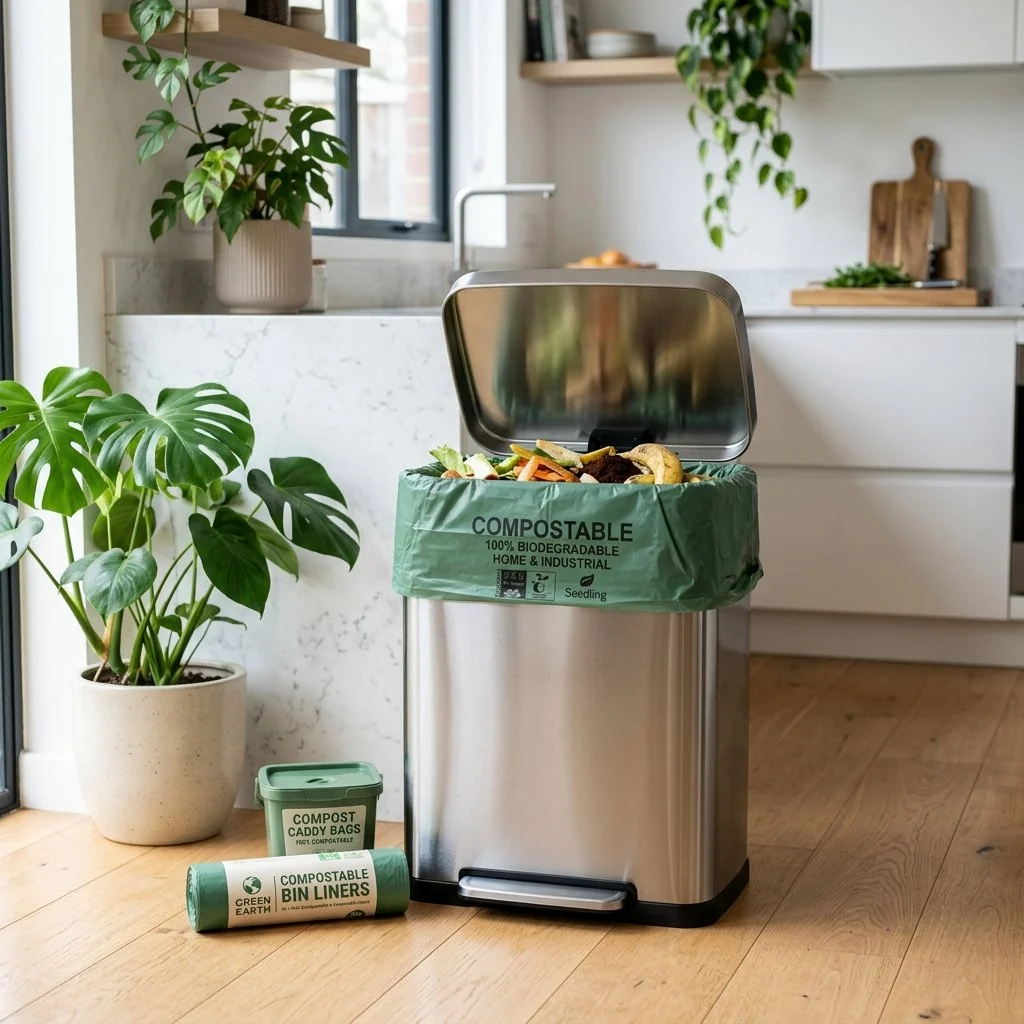
The line this standard is stated for
Our compost and bin liners are manufactured to meet ASTM D6400. They are built for wet waste, which is where the standard matters most: the liner composts alongside what is inside it, instead of being the one thing in the bin that survives.
This standard is stated for the bin liner line. Our other lines are made from the same corn and vegetable starch material, and we describe them as 100% compostable — but we do not claim ASTM D6400 across the range.
View compost & bin linersPlain language
What “compostable” actually means
Compostable, biodegradable and recyclable are not three words for the same thing. They describe three different endings, and only one of them ends in soil.
Compostable
Becomes soil, within a defined time, leaving nothing harmful.
- Has to break down completely into carbon dioxide, water and biomass.
- Has a time limit attached — and a standard, such as ASTM D6400, that sets it.
- The compost left behind has to be safe enough to grow plants in.
- Needs the right conditions: a managed composting environment, not a bin bag in a landfill.
Biodegradable
Will break down eventually. That is the entire promise.
- No time limit. Eventually can mean months, or it can mean centuries.
- No requirement about what is left behind once it has broken down.
- Everything compostable is biodegradable. The reverse is not true.
- On its own, the word tells a buyer almost nothing.
Recyclable
Can be reprocessed into new material — if it is collected.
- Stays in the material stream rather than returning to soil.
- Depends entirely on collection and sorting infrastructure being there.
- Most plastics lose quality each cycle, so it delays disposal rather than ending it.
- A recyclable bag that is not collected is simply a plastic bag.
One more label to watch for. Materials sold as oxo-degradable or simply degradable are conventional plastics with an additive that makes them fall apart faster. Falling apart is not composting — it produces smaller pieces of plastic, not soil. It is the distinction the whole category turns on.
Evaluating us against a spec?
Tell us the line and the application you are assessing, and we will walk you through the material, the sizes and how it is made.